Short answer: A mutual fund Riskometer shows a scheme’s disclosed risk level, not its expected return or a guarantee of safety. Read the current label alongside the exact scheme name, its objective and portfolio information, then consider your own need for the money. A coloured indicator is a useful starting point for questions, not a complete investment decision.
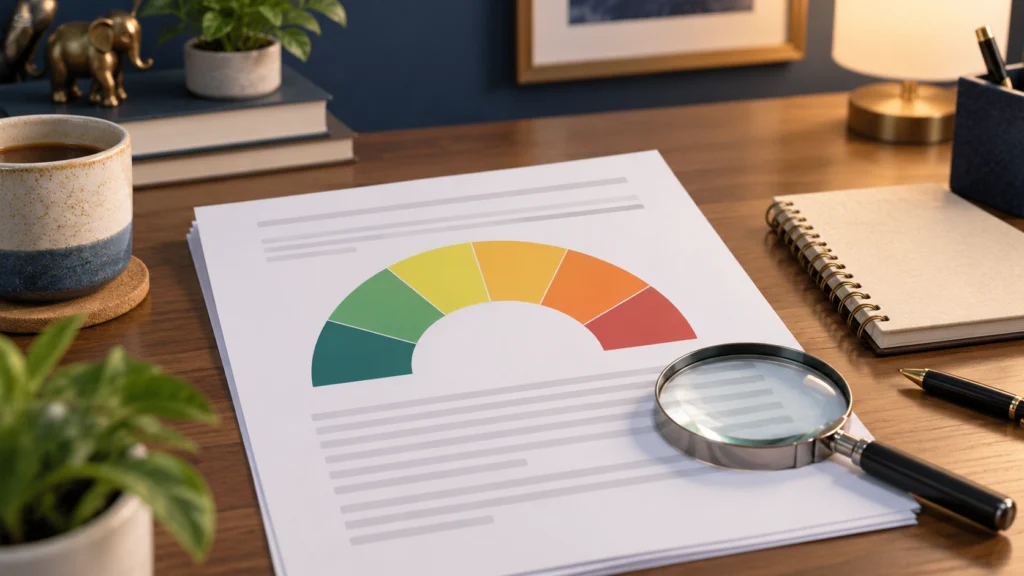
This guide helps Indian retail investors interpret the disclosure without turning it into a fund ranking. It does not recommend a particular scheme, tell readers to buy or sell, or assign an unofficial risk score to their holdings. Personal suitability depends on circumstances that a public article cannot establish.
Read the mutual fund Riskometer labels accurately
SEBI’s 20 March 2026 mutual-fund master circular, section 6.16, specifies six labels: Low, Low to Moderate, Moderate, Moderately High, High and Very High. Use the written label rather than estimating a risk level from a colour or the position of a small image on a phone screen.
The SEBI investor explanation describes the Riskometer as a way to communicate scheme risk. Its text introduces “five” categories but actually lists six. The operative circular explicitly confirms six; readers should use that primary regulatory reference for the label set rather than reproduce the inconsistent introductory count.
Do not interpret the word Low as a promise that your full investment cannot fall or that money is available at exactly the value you expect. The label is part of the risk disclosure. It does not replace the scheme documents, account terms or the particular reasons why you are considering the investment.
Similarly, Very High is not a forecast of a high profit. A statement about risk and a claim about expected return answer different questions. If a salesperson uses the dial as a selling shortcut, ask them to explain the underlying investment objective and the possible adverse outcomes in ordinary language.
Confirm the scheme and the disclosure date
Open the fund house’s official document for the exact scheme you are considering or holding. Record its title, the scheme name and the date or reporting period. A screenshot taken from an old message can make a genuine disclosure appear current when it describes an earlier portfolio.
Read the caption beside the indicator. SEBI’s circular distinguishes scheme and benchmark disclosures in relevant material. Do not accidentally copy the benchmark’s label into your note as though it were the scheme’s. Where both appear, write each separately and retain the surrounding caption.
Match the investment to your actual records. Our consolidated account statement guide explains how to identify scheme names and holdings. That record check establishes what you hold; it does not itself calculate the scheme’s risk level.
When a document, app and forwarded image appear inconsistent, first compare their dates and the object being described. Ask the fund institution which current disclosure applies. Do not average the labels, infer the answer from recent performance or choose whichever version supports a decision you have already made.
Use the label to ask better questions
Read the scheme objective and portfolio description before asking why the risk level applies. What kinds of assets does the scheme hold? Which exposures could affect its value? What information does the fund publish about those exposures? These questions produce more useful discussion than asking whether a colour is “good”.
SEBI’s investor explanation points to underlying assets, market volatility, credit risk and interest-rate sensitivity among relevant risk considerations. This article does not recreate the official calculation methodology or claim to rate a real portfolio. Ask for an explanation of the current disclosure rather than trusting an improvised score made from a few headlines.
Keep a list of uncertainties. For example, you may understand that the scheme invests in debt instruments but still be unable to explain what a particular credit exposure means for you. That gap is a reason to seek clarification, not a reason to assume that a familiar product category has removed the risk.
If an explanation only repeats the scheme’s name or historical return, ask it to address the risk question directly. Retain the official documents and distinguish statements made by the institution from your own notes. Do not convert a reassuring conversational answer into a guarantee that is absent from the written terms.
Separate the scheme’s label from your own circumstances
The same disclosure can lead different readers to ask different questions. Someone who needs money for a fixed upcoming expense has a different planning problem from someone with flexible timing and other resources. The Riskometer does not know either person’s obligations, savings or ability to cope with a loss.
Write down the purpose of the money and when you may need it. Identify whether that timing can change and what would happen if the investment were worth less at the point you need to use it. These are planning questions, not a recommendation that a particular label is suitable for every goal of a stated duration.
Distinguish willingness from financial capacity. You may feel comfortable with market fluctuations while still lacking spare resources for an essential payment. Conversely, being anxious about an unfamiliar investment does not tell you what its formal risk label should be. Do not force personal feelings and product disclosure into a single number.
Where you need personalised advice, consult an appropriately qualified and authorised professional and verify the service independently. Give them relevant circumstances through a legitimate channel. This article cannot determine how much you should invest or which scheme fits your situation.
Compare several dimensions rather than ranking by colour
Two schemes carrying the same label can still differ in objective, portfolio, costs and investor service. A comparison should identify the actual decision being made. Are you comparing schemes with different exposures, or two plans of the same scheme? Those are different exercises.
Our direct versus regular mutual-fund plan guide covers the latter cost-and-support comparison. A plan label does not replace reading the scheme’s current risk disclosure. Equally, a Riskometer comparison does not answer every question about the distribution route or fees.
| Comparison field | What to record | Question left open |
|---|---|---|
| Scheme identity | Exact name and document date | Are these the intended products? |
| Risk disclosure | Current scheme label and caption | Which exposures explain it? |
| Objective | Official scheme description | Does the purpose fit the goal being considered? |
| Costs and support | Applicable current documents | What service and charges apply? |
| Your circumstances | Need, timing and unanswered questions | Is personalised advice required? |
This worksheet is an original review aid, not an official SEBI questionnaire. Do not turn the number of completed rows into a suitability score. A single unresolved material question may matter more than several easy administrative checks.
An illustrative review before committing money
Imagine a reader collecting information about a scheme for money linked to an upcoming household expense. The reader sees a risk label in a forwarded image and initially focuses on a favourable return figure beside it. They then obtain the current official document and identify the exact scheme, its risk label and its objective.
The useful next question is what an adverse outcome would mean for the household expense, and whether the reader understands the relevant exposures. The process does not require guessing a future return or inventing a model loss figure. It may reveal that the reader needs more information or individual advice before making any commitment.
This is a hypothetical organising method, not a recommendation of a fund, a prediction of loss or a real investor story. It deliberately leaves the investment decision open because the article has not established the reader’s circumstances.
What to do when a risk label changes
The master circular requires monthly evaluation and provides for communicating changes to scheme or benchmark Riskometers. If you receive a change notice, read which object changed and compare the old and new captions. This guide does not announce that a particular fund’s label has changed.
Keep the notice and the current supporting document. Ask the institution what explains the change and which disclosure applies to the holding. Review whether the questions you originally asked about your goal and the product still have satisfactory answers. Do not assume a change demands the same buy-or-sell response from every investor.
A missing email is not reliable evidence that no update occurred. Check the current official disclosure rather than relying only on your inbox. Where a material service question remains unresolved, retain your request and acknowledgement; our SEBI SCORES complaint guide explains a separate escalation process when applicable.
Frequently asked questions
Is the Riskometer a return forecast?
No. It communicates risk. Assess return claims separately and do not treat the label as a promise of profit.
Should I use a scheme or benchmark label?
Read the captions and retain each separately when both are shown. They describe different objects and should not be silently substituted.
Do equal labels make two schemes identical?
No. Examine the objective, portfolio, terms and other relevant documents. A shared label does not settle all comparison questions.
Final mutual fund Riskometer checklist
Find the exact current scheme disclosure, read its written label, separate any benchmark indicator, understand the exposures and consider your own goal. Use the mutual fund Riskometer to organise a careful review rather than shortcut the investment decision.
Author: Ajit Naskar. Publication date: 14 October 2026. Updated and last verified: 14 October 2026. Correction history: First publication; no published corrections. Educational information, not personalised investment or tax advice. No affiliate links. Evergreen guide, not a new-rule announcement or filing deadline.
Leave a Reply