Short answer: To verify gold hallmark HUID, inspect the mark on the actual jewellery, use the official BIS Care app’s Verify HUID feature and compare the result with the item and its invoice. A successful lookup is useful evidence about the recorded article; it does not replace examining the jewellery, understanding its price or obtaining an assay when a purity dispute requires testing.
This guide is for someone considering HUID-bearing gold jewellery in India. It covers a purchase check, not a recommendation to invest in gold or a claim about future resale value. Old jewellery, altered articles, coins and different hallmarking regimes can require separate treatment. Do not apply one screenshot from a current gold-jewellery lookup to every precious-metal product.
Read the article before you verify gold hallmark HUID
The BIS general hallmarking FAQ identifies three components of the HUID-era gold hallmark: the BIS mark, purity expressed in caratage and fineness, and a six-character alphanumeric HUID. Look for the complete set on the item under discussion, rather than accepting an isolated number on a tag as the entire check.
Ask the jeweller to show the marks clearly before the sale. Small engraving can be hard to read under ordinary shop lighting. Read each character carefully and make sure the article being shown is the one you are buying. A mark demonstrated on a similar display item does not identify the article in your tray.
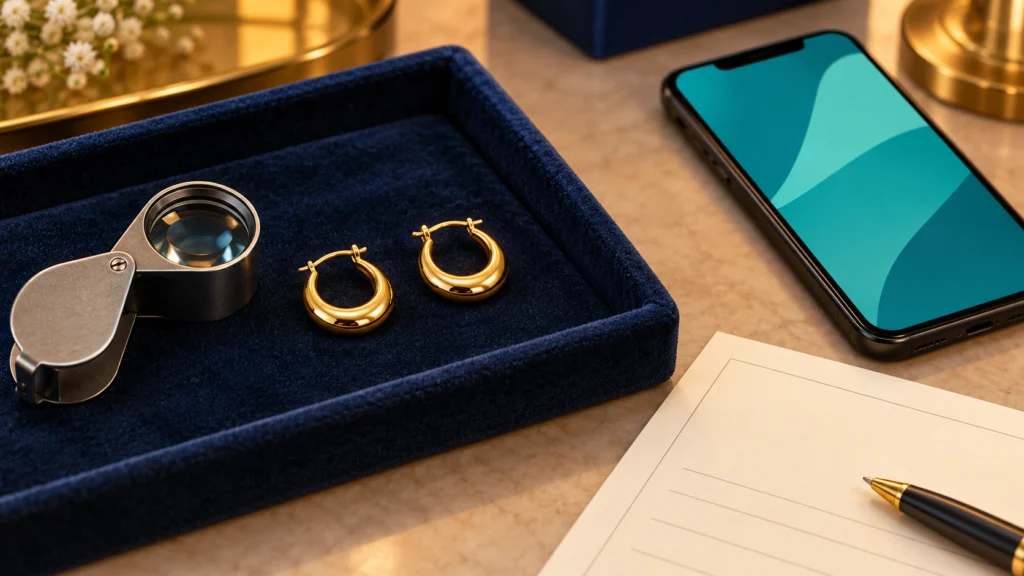
The same BIS FAQ says that articles in a pair and detachable parts should carry their own hallmarks and different HUIDs. Treat a pair as more than one object for inspection. Ask which marks correspond to each relevant component instead of assuming that one readable code settles every part.
Do not scratch, file, chemically test or otherwise damage an article to inspect it. A consumer’s visual check is an identification step. Where marks are unreadable or a seller cannot explain which part bears them, pause and seek a clear explanation before treating the item as verified.
Use the official BIS Care verification feature
BIS’s consumer-protection guidance identifies Verify HUID in BIS Care as the official lookup for HUID-bearing gold jewellery. Reach the app through BIS’s own website or recognised app-store listing and check its publisher. An unsolicited payment link or a seller’s private verification page is not equivalent to the official service.
Open the relevant feature and enter the characters read from the actual item. If a character is ambiguous, ask to see the mark again. Do not repeatedly guess several alternatives until one happens to return a result. A valid result for a different code would answer the wrong question.
Read the result in full and keep it connected to the item you inspected. Note the code and the facts displayed rather than relying on a reassuring colour or a seller’s verbal summary. This article has reviewed official public instructions; it has not performed a lookup for a real customer’s jewellery or fabricated a successful app result.
If you save an image of the result, keep it with your purchase evidence. A screenshot can be useful as a dated observation, but it is not a laboratory report. Avoid circulating an isolated screenshot as a certification of an article that other people have never examined.
Compare the record with the physical article
Use three linked observations: the code on the jewellery, the code entered into the official feature and the information returned. Write down what actually matches and what remains unclear. This simple chain is more reliable than remembering that somebody in the shop “checked something on a phone”.
Compare the displayed purity information with the purity represented for the article. If the shop’s description and official result differ, ask for an explanation before paying. Do not assume that a higher claimed carat value is established merely because a code exists.
BIS’s jeweller FAQ also explains that lookup information can identify a supplier or manufacturer registration and that related registration information can be searched through the official system. Do not confuse every business name in a supply chain with the retail seller’s name. Establish which entity each reference identifies.
Registration checking and item checking are related but different. A seller’s displayed registration does not by itself prove that a particular piece has the represented marks. Conversely, an item lookup does not explain every charge on the seller’s invoice. Keep both questions in view.
| Evidence | Question it helps answer | What it does not settle alone |
|---|---|---|
| Mark on the item | Which code and purity are represented? | Whether the entered app code was copied correctly |
| Official HUID lookup | What record is returned for that code? | Every physical or commercial characteristic |
| Seller’s invoice | What article and charges were sold? | An independent assay of actual purity |
| Recognised-centre assay report | What testing result applies to the identified sample? | Every separate contractual dispute |
Read the invoice before accepting the price
The jeweller FAQ says that a hallmarked-article sale invoice should separately identify the article, net precious-metal weight, purity in carat and fineness, and hallmarking charges. Ask to see a clear item-level breakdown. A single grand total can be difficult to connect to a later question about one piece.
Keep net precious-metal weight distinct from gross article weight. A piece containing other materials can have a gross weight that does not answer how much precious metal is being charged for. Ask the seller to identify the quantities used in the calculation instead of inferring them from how substantial the article feels.
Read making charges, other components and the tax calculation as separate commercial terms. Hallmarking concerns purity; it does not establish that a particular making charge is competitive or that a seller promises to buy the item back at today’s price. Obtain the actual sale, return and buyback terms that matter to your purchase.
HUID on the invoice is another point requiring care. The current BIS jeweller FAQ describes printing HUID numbers on invoices as voluntary. You may ask the seller to record an item-code association for a clearer evidence trail, but this guide does not turn that practical request into a universal legal invoice requirement.
Keep the final invoice, rather than only a quotation or payment notification. Check that it identifies the seller and article you actually bought. If a correction is needed, obtain it through the seller’s legitimate process and preserve the earlier version so the change can be understood.
Understand what a hallmark check cannot promise
A purity-related check does not forecast gold prices or guarantee investment returns. Jewellery includes design and commercial costs that may not be recovered on resale. This guide does not compare gold investment products or recommend allocating savings to jewellery.
Do not treat an app result as an opinion about gemstone quality, workmanship or every material in a composite article. Decide which characteristics are important and ask what evidence supports each claim. A statement can be accurate about one feature while leaving another purchasing question unanswered.
Different dates and product histories also matter. BIS distinguishes a returned HUID-bearing item from an old article melted into a new one. An old receipt or photograph should not be assumed to identify newly manufactured jewellery. Ask about the actual article’s history when it affects which evidence is relevant.
This article does not list every district, exemption or effective date under mandatory-hallmarking orders. Those orders can change. Use the current BIS order and its applicability if your question is whether a specific transaction must fall within mandatory coverage, rather than whether a presented HUID and item agree.
Respond to an unreadable code or mismatched result
If a lookup fails, first check the characters, the feature used and whether the service is functioning. An entry mistake or connection problem is not, by itself, proof of a counterfeit article. Equally, do not accept an unresolved failure as a successful verification because somebody says the app is unreliable.
Before purchase, the practical response to a material unresolved discrepancy is to pause. Ask the seller to show the mark again, explain the represented purity and identify the documents for that item. You do not have to invent the cause of the discrepancy to recognise that the check is incomplete.
If the concern involves an article you already own, preserve the item, invoice, relevant messages and lookup observation. Do not melt or substantially alter the article while trying to establish what was sold and represented. Ask the appropriate official or professional channel how the article should be identified and handled for examination.
BIS consumer-protection guidance says that consumers can use recognised Assaying and Hallmarking Centres for chargeable testing and an identified assay report. Ask the chosen recognised centre about its current procedure, charges and the effects of the proposed test before handing over the item. This guide does not promise that testing is free or non-destructive.
Where a properly established purity shortfall is involved, BIS publishes compensation provisions. A consumer should use the applicable official process with the evidence and report; this article does not calculate an individual’s entitlement from an app screenshot. Other disputes about delivery, pricing or contract terms may require their own route.
Example: a pair needs two clear checks
Imagine a fictional buyer examining a pair of gold earrings. The seller demonstrates a readable HUID on one earring, but the second item’s mark is unclear. The buyer asks to inspect the other earring instead of treating the first result as proof for the pair.
The buyer then compares the relevant lookup information with each article and asks for an invoice that clearly describes the pair’s precious-metal weight and purity. If the second mark remains unresolved, the buyer pauses rather than guessing a code. The example illustrates an inspection method; it is not a claim that a real seller committed misconduct.
After purchase, the buyer stores the invoice and recorded observations together. If a later concern concerns price rather than purity, the buyer can identify that distinction. Keeping the questions separate helps the seller or reviewing authority understand what evidence would actually resolve the issue.
Keep a usable consumer evidence trail
For a wider purchase dispute, our National Consumer Helpline complaint guide explains how to organise evidence and track that separate process. Do not confuse a general consumer grievance with a completed BIS assay or a decision about compensation.
Our Consumer Money guides cover related purchasing checks. Share only the information needed by the legitimate recipient. An invoice may include contact or payment details that do not belong in a public social-media post.
Frequently asked questions
Does one verified code cover every item in a pair?
BIS’s general FAQ calls for separate hallmarks and HUIDs for articles in a pair and detachable parts. Check the relevant items individually.
Does a successful lookup replace a purity test?
No. Treat a lookup record and a recognised-centre assay as different evidence serving different questions.
Does a hallmark guarantee a favourable resale price?
No. Read the seller’s commercial terms separately from the purity-related record.
Final checklist to verify gold hallmark HUID
Inspect the actual item, read every relevant mark, use the official feature, compare the record with the represented article and obtain a clear invoice. To verify gold hallmark HUID responsibly, preserve uncertainty when a check is incomplete and use recognised testing or official grievance routes for the question that remains.
Author: Ajit Naskar. Publication date: 17 October 2026. Updated and last verified: 16 October 2026. Correction history: Initial version; no published corrections. General consumer information, not investment or legal advice, a laboratory certification or an individual compensation decision. No new mandatory-coverage deadline or current gold price asserted. Independent of BIS and jewellers; no affiliate links. No private article tested.
Leave a Reply