Short answer: MRP and unit price answer different shopping questions. MRP is the maximum retail price marked for a covered packaged product, while a unit-price comparison puts different pack sizes on the same quantity basis. Check the net quantity, compare the actual selling price for an equivalent amount and then decide whether the larger purchase suits your needs.
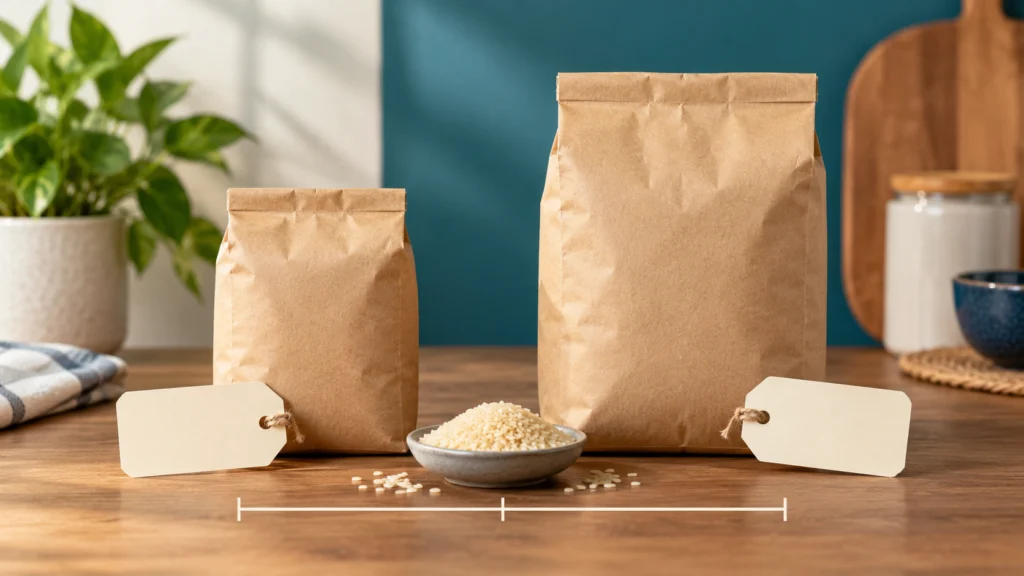
A lower pack price is not necessarily a lower price per gram, millilitre or item. A larger discount percentage is not necessarily a better purchase either. This guide gives an original comparison method for ordinary pre-packaged retail goods in India. It does not decide a particular legal dispute, set a product’s quality standard or announce a new GST rate.
Read MRP and unit price alongside net quantity
The Department of Consumer Affairs’ Legal Metrology overview explains pre-packaged commodities and the declarations used on retail packages. Those include the product description, net quantity, manufacturer or importer details, consumer-care information and an MRP inclusive of taxes. Read those fields together rather than treating a promotional badge as the whole label.
The Department’s Packaged Commodities FAQ distinguishes the retail ceiling from the price actually charged: covered goods may be sold below MRP. The same FAQ describes unit sale price as price per specified measurement or number. The printed declaration and your own calculation from an offered selling price can therefore answer different questions.
For shopping, keep three figures separate: the package’s marked MRP, the retailer’s current selling price and the quantity being sold. If you calculate an effective price using a discount, label your result as your comparison at that offer price. Do not present it as a correction to the manufacturer’s printed declaration.
Scope matters. This guide concerns ordinary covered retail packages. Loose goods, specialised products, wholesale or institutional supplies and service-related transactions can raise different questions. Do not use a supermarket comparison worksheet to pronounce on every restaurant bill, medicine price or specialised exemption.
Choose the same measurement before dividing
Write down the net quantity, not the size of the box or a visual estimate of how full it looks. A tall container and a compact refill can hold different quantities despite similar shelf space. The package’s dimensions are not the denominator for a price-per-quantity calculation.
Use the same unit for both products. Convert kilograms to grams or litres to millilitres when necessary, then compare a convenient common amount. For example, a price per 100 grams can be easier to read than a small decimal per gram. Show the unit next to every answer.
Do not compare mass with volume as though they were interchangeable. A 500-gram package and a 500-millilitre bottle cannot be treated as equal quantities merely because both display 500. If the products use different measures, select a comparison relevant to their actual use or acknowledge that the simple calculation is insufficient.
For goods sold by number, check what one counted item means. Two packs may contain different sizes or specifications of item. A lower price per piece can be real while the pieces themselves are not equivalent. Quantity comparison helps organise a choice; it does not erase product differences.
| What you compare | Useful common basis | Check before using it |
|---|---|---|
| Same kind of product sold by mass | Price per 100 g or per kg | Equivalent product and net mass |
| Same kind of product sold by volume | Price per 100 ml or per litre | Equivalent concentration and volume |
| Comparable counted items | Price per item | Size and specification of each item |
| Different formulations | Relevant usable output, if reliably known | Do not invent a conversion or performance claim |
Work through a transparent price comparison
Use this formula for an original shopping calculation: actual pack price divided by net quantity, multiplied by the chosen comparison quantity. Keep the price and quantity for the same pack on the same line. A common mistake is to copy one pack’s price beside another pack’s quantity.
Consider two fictional offers for the same type and specification of product. Pack A contains 400 grams and costs ₹96. Pack B contains 750 grams and costs ₹165. These are invented arithmetic examples, not market prices, recommended purchases or evidence of any seller’s conduct.
| Pack | Price used | Net quantity | Calculation per 100 g |
|---|---|---|---|
| A | ₹96 | 400 g | 96 ÷ 400 × 100 = ₹24 |
| B | ₹165 | 750 g | 165 ÷ 750 × 100 = ₹22 |
Pack B costs ₹69 more at checkout but ₹2 less per 100 grams under these assumptions. Both statements can be true. The first concerns today’s outlay; the second concerns an equivalent quantity. Which matters more depends on what you need and can use, not on a claim that the bigger pack always wins.
Now compare the same amount: 750 grams at Pack A’s unit rate would cost ₹180, while Pack B costs ₹165. The equivalent-quantity difference is ₹15. This is a mathematical comparison, not necessarily a cash saving you can obtain by buying a fractional pack that the shop does not sell.
Keep sufficient precision during the calculation and round the displayed result sensibly. If two options differ only slightly, avoid claiming a meaningful saving from a rounding artefact. Recheck the input figures before interpreting a surprising result.
Treat coupons, multipacks and free items carefully
Use an offer price only when you qualify for it and intend to meet its conditions. A members-only price, minimum-order coupon or particular payment offer may not be available for your purchase. Record the condition beside the number rather than silently applying the best advertised price to every shopper.
For a multipack, establish the total quantity actually included. “Pack of three” is incomplete information if the units differ in size. Read the individual quantities and check whether the listing describes three full products, samples or a bundle containing different items.
Distinguish the legally declared unit sale price from your household assessment of a promotion. The Department’s FAQ discusses particular declaration treatment for free quantities and free packs. Your personal effective-cost calculation should state exactly which usable items you counted; do not assume that your calculation determines whether a label complies with every rule.
If a bundle contains an extra product you would not otherwise buy, assigning it the full standalone selling price can exaggerate the value to you. Compare the amount you are actually willing to pay for the bundle with the alternative you would realistically purchase. Do not turn a hypothetical extra into a guaranteed saving.
A percentage discount also depends on its reference price. Calculate the amount payable and inspect the quantity before judging the percentage. A dramatic discount on one pack can still produce a higher unit cost than another pack with a smaller advertised discount.
Account for storage, budget and usable quantity
The lowest price per unit does not always minimise your spending. A bulk pack requires a larger immediate payment and suitable storage. If you need only a small amount, buying excess stock can leave money tied up in a product you would not otherwise purchase.
Read the product’s own use-by, best-before, storage and opening instructions where relevant. This article does not provide food-safety advice or extend a manufacturer’s date. Use the actual instructions for the specific product when deciding whether you can sensibly use the quantity.
Consider an original household-planning check: how much would you use over a normal purchase cycle, and how much would remain? You do not need a precise consumption forecast. A realistic range is enough to reveal when a small unit-price advantage depends on buying far beyond your needs.
Quality and suitability remain separate. A product with a different formulation, size or performance is not automatically an equivalent substitute. State those differences rather than using arithmetic to imply that the cheaper option will perform identically. Avoid unverified claims about concentration or number of uses.
Check the final item and bill
Before paying, compare the selected pack with the shelf label or online listing. Confirm the variant, quantity, offer conditions and item-level price. A shelf label for a neighbouring size can explain a mismatch without establishing deliberate overcharging.
Distinguish the item’s tax-inclusive price from a separately itemised tax breakdown. Seeing a tax line is not enough, by itself, to establish that tax was charged twice. Check the final amount attributed to the item and ask the seller to explain the arithmetic.
Keep delivery, platform or other separately described order charges distinct from the product’s unit-price calculation. If you compare whole orders, include applicable charges consistently on both sides. Do not quietly include a delivery charge in one comparison while excluding it from another.
If an MRP sticker or revised price is unclear, preserve the package and ask for the basis of the revised amount. This guide does not decide the validity of a particular relabelling exercise or extend a temporary government permission. Avoid treating an old GST-relabelling notice as a permanent rule for every package.
Ask a focused question when figures do not match
Keep the bill, relevant listing or shelf-label record and a readable image of the package’s price and quantity declarations. Describe the specific difference: the expected item price, the billed item price and the evidence linking them to the same pack.
Start with a factual request for clarification or correction through the seller’s legitimate channel. A comparison mistake, an expired promotion and a disputed price declaration require different explanations. State what you observed rather than asserting a legal conclusion that the evidence does not yet establish.
If a consumer grievance remains, our National Consumer Helpline evidence and tracking guide explains that separate route. Questions about packaged declarations or measurement may also need the responsible Legal Metrology authority identified through the Department. No refund, penalty or resolution time is promised here.
Our Consumer Money guides cover related practical purchasing decisions. Keep the present calculation with your evidence so someone reviewing the issue can reproduce it. Do not post payment identifiers, address details or unrelated personal information publicly.
Frequently asked questions
Is the lowest pack price always cheapest?
No. Compare equivalent quantities and then consider how much you need to buy and use.
Should I use MRP or the selling price in my comparison?
Label the purpose clearly. Use the actual available selling price for your purchase comparison, while retaining the marked MRP as a separate figure.
Does this calculation prove a legal violation?
No. It helps identify a discrepancy. Applicability, exemptions and the evidence of a particular transaction need separate checking.
Final MRP and unit price checklist
Match the product, read net quantity, choose equivalent units, use the price actually available to you, show your arithmetic and check the final bill. MRP and unit price are useful together when neither is mistaken for a complete judgement about value, quality or legal entitlement.
Author: Ajit Naskar. Publication date: 17 October 2026. Updated and last verified: 16 October 2026. Correction history: Initial version; no published corrections. General consumer information, not legal advice. Fictional arithmetic examples; no current market prices, new GST rate or universal deadline asserted. No affiliate links. CheckMatter is independent of the Department and sellers.
Leave a Reply