PM Surya Ghar Subsidy: Eligibility, Application and “Free Electricity” Explained
Short answer: PM Surya Ghar: Muft Bijli Yojana supports eligible residential rooftop-solar installations through the official national portal, approved vendors, DISCOM verification, and central financial assistance. The phrase “free electricity up to 300 units” is an energy-generation objective, not a promise that every household receives 300 free grid units or the same cash amount. Actual savings depend on solar capacity, sunlight, consumption, tariffs, net-metering rules, and system performance.
Author: Ajit Naskar · Draft date: 20 September 2026 · Updated: 20 September 2026 · Last verified: 20 September 2026
Eligibility, subsidy rates, vendor availability, technical approvals, and net-metering rules can change. Verify the current details on the official portal and with your DISCOM before paying a vendor.
Table of contents
- What PM Surya Ghar actually provides
- Who can apply
- Current central subsidy structure
- Application and installation steps
- What “300 units free” means
- Costs, scams, example, and FAQs
What is PM Surya Ghar: Muft Bijli Yojana?
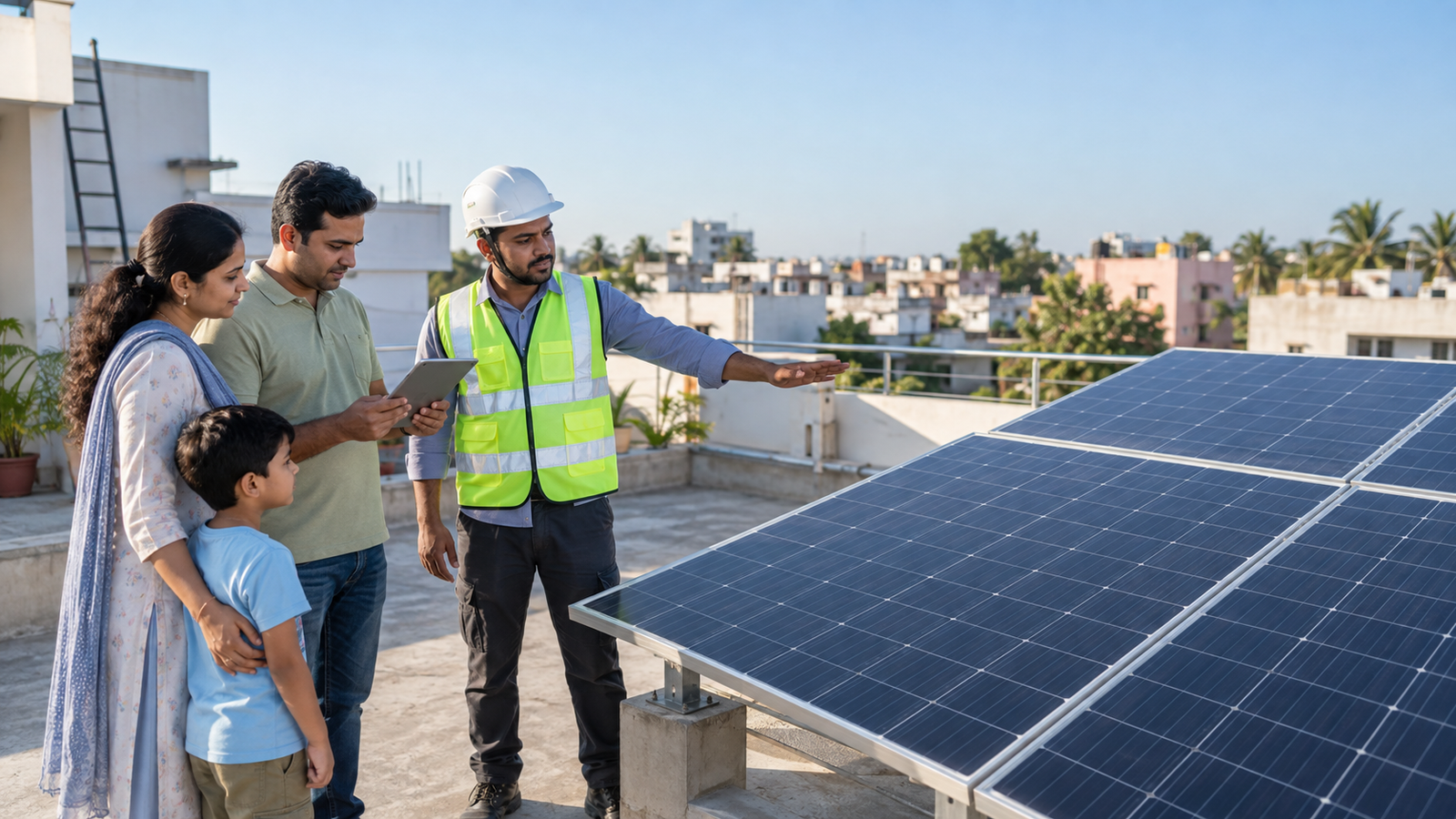
PM Surya Ghar is a central residential rooftop-solar programme approved in 2024 with an outlay of ₹75,021 crore and a national objective of supporting rooftop systems for one crore households. The programme uses the National Portal for Rooftop Solar to connect consumer applications, electricity-distribution-company processes, registered vendors, inspection, commissioning, and subsidy disbursal.
The scheme does not install a free system at every home. A consumer normally selects a suitable capacity, completes the DISCOM process, contracts with a registered vendor, pays the consumer share, commissions the plant, and then receives eligible central financial assistance after required verification. State support, financing, and utility procedures can differ.
PM Surya Ghar subsidy eligibility
The central financial assistance is aimed at residential electricity consumers installing eligible grid-connected rooftop solar. The applicant should have a residential electricity connection, rights or permission to use the roof, a technically suitable site, and an application processed through the official mechanism. Commercial and industrial consumers do not receive the residential household subsidy merely because panels are installed on a building.
Apartment owners may face a choice between an individual installation linked to an eligible connection and a group-housing or resident-welfare-association system for common facilities. The guidelines contain a separate structure for GHS or RWA common facilities, including capacity limits linked to the number of dwellings. Individual residents should not assume that a society-level plant automatically credits their household bill.
A roof must have adequate unshaded area and structural suitability. Local building, fire, electrical-safety, and DISCOM requirements continue to apply. A portal registration or vendor quotation is not a technical approval.
How much central subsidy is available?
Under the original national guidelines for ordinary residential consumers, the central financial assistance structure was ₹30,000 per kW for the first 2 kW and ₹18,000 for the additional third kW, producing a maximum central subsidy of ₹78,000 for systems of 3 kW or more. The payable amount is subject to the portal, benchmark costs, eligibility, installation date, technical compliance, and any later amendment.
Do not rely on an old social-media card or assume the rate applies unchanged in every location. Check the live portal before signing a contract. State governments or DISCOMs may offer separate support, but a vendor should identify the legal source, eligibility conditions, and payment mechanism rather than simply adding an unverified “extra subsidy” to a sales pitch.
The subsidy is not the total price. The consumer pays the difference between the vendor’s agreed system cost and applicable assistance, together with any non-covered work. Financing can spread the cost but creates interest and repayment obligations. Compare the cash price, financed price, annual percentage cost, warranties, expected generation, and maintenance terms.
How to apply for PM Surya Ghar online
- Use the official portal. Start at pmsuryaghar.gov.in and confirm the domain before entering consumer information.
- Select your state and DISCOM. Register using the electricity-consumer details requested by the portal.
- Submit the rooftop-solar application. Enter the proposed capacity and site information accurately.
- Wait for feasibility or DISCOM approval. Do not treat registration alone as permission to install.
- Select a registered vendor. Compare multiple offers where available and verify the vendor listing on the portal.
- Sign a detailed contract. Include module and inverter specifications, capacity, structure, earthing, warranties, price, taxes, timeline, approvals, and after-sales service.
- Complete installation and documentation. Ensure the system matches the approved design and applicable technical standards.
- Request inspection and commissioning. The DISCOM verifies the installation and completes the meter or grid-connection process.
- Submit subsidy-bank details through the official flow. Recheck the account holder, number, and IFSC.
- Track disbursal. Preserve the application, approval, invoices, inspection records, commissioning certificate, and portal status.
Documents and information to prepare
The portal and DISCOM may request the electricity consumer number, identity and contact information, recent bill, address, proposed system details, roof ownership or permission, bank information for subsidy, cancelled cheque or other verification, vendor invoice, installation photographs, commissioning documents, and meter-related records. Requirements can vary by stage and utility.
The name on the electricity connection, portal application, bank account, and property or permission records should be checked for mismatches. If an identity detail needs correction, our Aadhaar update guide explains common online and centre-based routes. Do not upload identity documents to an unofficial vendor link merely because it uses the scheme’s name.
What does “free electricity up to 300 units” mean?
The scheme’s public objective is to enable participating households to generate electricity from rooftop solar, potentially reducing their monthly bill and supporting generation equivalent to up to 300 units for a suitably sized and performing installation. It is not a universal entitlement to 300 free units supplied by the grid.
A household’s result depends on installed capacity, solar radiation, roof direction and tilt, shade, dust, temperature, equipment efficiency, downtime, self-consumption, export credit, fixed charges, minimum charges, taxes, and the state’s net-metering or billing rules. A low-consumption household can export more electricity; a high-consumption household may still draw significant grid power.
Even when energy charges fall sharply, the bill may not become zero. Fixed, demand, meter, service, arrears, or other permitted charges can remain. Ask the DISCOM how imported and exported units are measured and settled.
How to choose rooftop-solar capacity
Start with at least 12 months of electricity bills. Calculate average monthly units and note seasonal peaks. A vendor should estimate annual generation using local solar conditions, roof constraints, equipment losses, and downtime—not simply divide one month’s bill by a marketing number.
Capacity should also reflect the sanctioned load, DISCOM limits, available roof area, structural condition, shade throughout the year, future appliance use, and the economics of exports. Oversizing solely to reach the maximum subsidy can produce a poor return if export credit is low or the roof is unsuitable.
Request a written generation estimate with assumptions. Treat it as an estimate, not a guarantee. Compare expected savings with the unsubsidised consumer cost, financing cost, inverter replacement risk, cleaning, insurance, and warranty enforcement.
Vendor comparison checklist
- Current registration on the official portal.
- Exact module make, model, wattage, certification, and product warranty.
- Inverter type, capacity, protection features, and warranty.
- Mounting structure material, wind design, waterproofing, and corrosion protection.
- Earthing, lightning protection, cables, isolators, and safety labelling.
- All-inclusive price and a list of exclusions.
- Responsibility for DISCOM documents, inspection, and net meter.
- Installation timeline and delay terms.
- Generation estimate and its assumptions.
- Service contact, response time, and workmanship warranty.
Do not choose solely on the lowest price. Substituted equipment, unsafe wiring, weak structure, or missing after-sales support can cost more than the initial difference.
Example: a household considers a 3 kW system
Suppose a family uses about 280 units a month on average and has an unshaded, structurally suitable roof. It applies through the portal, receives DISCOM feasibility approval, and compares registered vendors for a 3 kW installation. Under the original central structure, a qualifying 3 kW installation could be eligible for up to ₹78,000 in central assistance.
The family should not subtract ₹78,000 from a verbal quote and pay immediately. It should verify the live eligible amount, contract price, equipment, approvals, meter process, and bank-disbursal conditions. After commissioning, the bill will depend on actual generation and the DISCOM’s treatment of imports, exports, and fixed charges. The example illustrates a process, not a savings guarantee.
What does not change under the scheme?
The consumer remains responsible for electricity bills, loan repayments, safe operation, access for inspection, and compliance with utility rules. The subsidy does not transfer roof ownership, guarantee uninterrupted electricity during outages, or turn an ordinary grid-tied system into backup power. Without suitable batteries and islanding equipment, many grid-tied systems shut down during a grid outage for safety.
The scheme also does not guarantee that every roof is feasible, every vendor quotation is fair, or every installation will generate the same number of units. DISCOM approval, equipment quality, engineering, and maintenance still matter.
PM Surya Ghar scam warning
Use only official portals and verified DISCOM channels. Be cautious of unsolicited calls promising immediate subsidy, mandatory registration fees, guaranteed zero bills, or “government-approved” equipment without a portal listing. Never share OTPs, UPI PINs, net-banking passwords, or remote-screen access. Pay only according to a written contract and traceable invoice.
A government logo in a message is not proof. Verify the domain, vendor status, application number, and subsidy stage independently. For a broader public-service document check, see our DigiLocker document verification guide.
How PM Surya Ghar differs from another benefit scheme
PM Surya Ghar is an asset-installation programme tied to a residential electricity connection, technical approval, and rooftop system. It should not be confused with health, worker, or cash-transfer schemes. Our e-Shram registration guide explains why registration in a government database does not itself guarantee a universal cash benefit; the same verification discipline applies here.
Frequently asked questions
Is rooftop solar completely free under PM Surya Ghar?
No. Eligible households receive central financial assistance toward an approved installation. The consumer generally pays the remaining cost and any non-covered work.
Does everyone get ₹78,000?
No. ₹78,000 is the maximum under the original ordinary residential structure for eligible systems of 3 kW or more. The live portal, capacity, location, application, and compliance determine the actual amount.
Will my bill become zero?
Not necessarily. Generation, consumption, export-credit rules, fixed charges, and system performance determine the bill.
Can a tenant apply?
The applicant needs an eligible residential connection and the required right or permission to install on the roof. Confirm the portal and DISCOM requirements for rented premises.
Can I use any solar vendor?
For subsidy processing, use a vendor registered under the official portal and follow the applicable programme process.
Does ordinary rooftop solar work during a power cut?
A standard grid-tied system generally shuts down during an outage for safety unless an approved backup and islanding arrangement is installed.
Is there a universal application deadline?
Do not rely on a forwarded deadline. Check the live portal and official MNRE or DISCOM notice for current programme availability and any state-specific cutoff.
Action checklist
- Review 12 months of electricity use.
- Check roof ownership, shade, area, and structural condition.
- Register only through the official portal.
- Obtain DISCOM feasibility approval before installation.
- Compare registered vendors and written specifications.
- Confirm the live subsidy amount and consumer share.
- Complete inspection, commissioning, and meter formalities.
- Submit bank details only through the official process.
- Track actual generation and bills after commissioning.
Conclusion: The PM Surya Ghar subsidy can materially reduce the cost of eligible residential rooftop solar, but it is not an automatic free-system or 300-free-grid-unit promise. Verify eligibility, size the system from real consumption and roof conditions, use an approved vendor, and complete the DISCOM and portal process before expecting subsidy.
Official sources: MNRE scheme guidelines; PM Surya Ghar administrative approval and implementation framework; PM Surya Ghar national portal.
Correction history: 20 September 2026 — first draft.
Leave a Reply