Quick answer: If an ATM debits your account but dispenses no cash, record the ATM and transaction details and report it to the bank that issued your card. For a covered domestic technical failure, RBI’s framework sets reversal by T+5 calendar days and ₹100 per day for a qualifying delay beyond that limit. Report promptly rather than waiting for the deadline. A withdrawal you did not make needs the unauthorized-transaction route immediately.
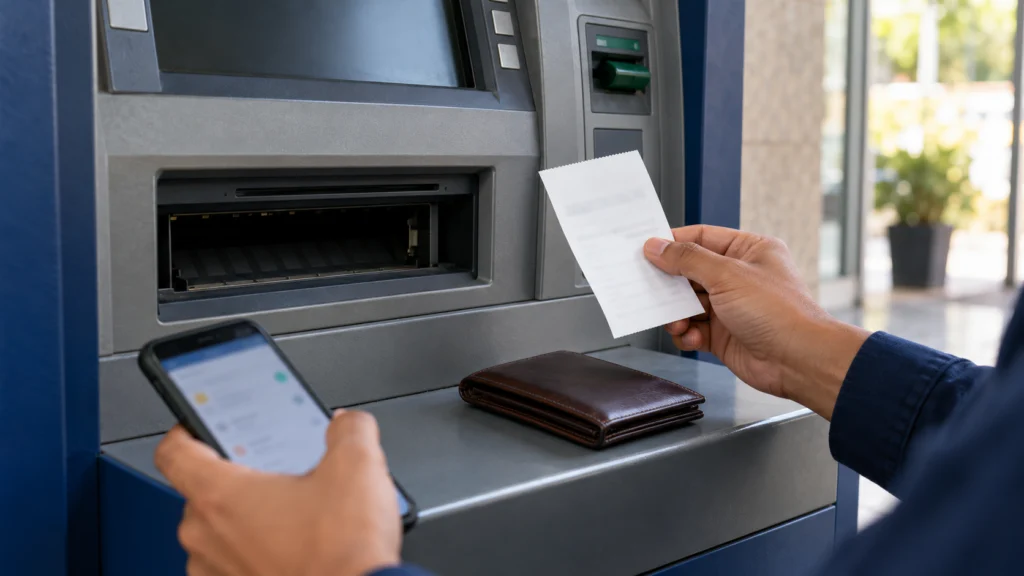
Identify the ATM problem accurately
| What happened | What to tell the issuer |
|---|---|
| No cash dispensed; account debited | Report a failed cash withdrawal and provide the terminal and transaction reference. |
| Only part of the requested cash arrived | Record the exact amount received and the shortage; request a cash-dispense investigation. |
| ATM said failed and statement shows no debit | Check for a later posted debit; retain the error/receipt. |
| You did not attempt the withdrawal | Report an unauthorized withdrawal immediately and secure the affected channel. |
The no-cash rule below should not be read as a promise that every partial-cash dispute gets the entire debit reversed. Give the issuer the precise shortfall and ask it to explain how the applicable rule and ATM records apply.
The RBI timeline for no cash dispensed
The failed-transaction framework covers domestic system failures not attributable to the customer. T is the transaction’s calendar date. For an account debit with no cash dispensed, the outer reversal limit is T+5; eligible delay compensation is ₹100 per day after that. The framework says compensation should be credited without waiting for a separate customer claim.
These are calendar-day limits for this failure type, not a general five-working-day waiting period. The bank should aim to resolve the problem earlier. A complaint acknowledgement helps establish the trace; it is not itself a reversal entry.
What to do at the ATM and soon afterwards
- Keep the receipt or displayed error, where available.
- Note the ATM ID, bank/operator name, location, attempted amount and exact time.
- Check your bank statement for the debit and any matching reversal.
- Use the card issuer’s official app, helpline or complaint channel; do not rely on a telephone number pasted near the ATM.
- Say whether you received no cash or a partial amount. Save the complaint number.
- If the card is retained or the withdrawal was not yours, ask the issuer to secure it immediately.
The ATM operator may hold machine records, while your issuer is the starting point for your account complaint. Ask the issuer to coordinate the trace and preserve relevant ATM records. You do not need to post sensitive account information publicly to explain the problem.
Build one evidence packet
- Attempted withdrawal amount and the amount actually received.
- Transaction date/time, ATM identifier and location.
- Redacted debit entry and any reversal entry.
- Receipt or error description, if available.
- Issuer complaint reference, first report time and later replies.
- The specific unresolved point: missing reversal, short cash or missing compensation.
If the receipt is unavailable, report anyway and describe the missing evidence accurately. The banking complaint checklist can organise the chronology.
Worked example: calendar-day calculation
In a fictional covered no-cash case, the debit occurs on 2 November. T+5 is 7 November. If the qualifying reversal is recorded on 9 November, the illustrative delay beyond the outer limit is two days, indicating ₹200 at ₹100 per day. The original withdrawal amount and delay compensation are separate entries to reconcile. Actual bank records and applicability decide the real result.
Example complaint wording
My account ending [last four digits] was debited ₹[amount] for an ATM attempt at [ATM ID/location] on [date/time]. The machine dispensed [no cash / amount received]. The reference is [reference]. My statement shows [current position]. Please investigate the dispense record, arrange the applicable reversal and explain any delay compensation due. Please acknowledge the report and provide a complaint reference and written response.
Follow up after a reversal or rejection
Compare the reversal with the original debit, rather than relying on an app banner. If only part of the amount returns, ask for the remaining difference and the bank’s reasons. If the bank says cash was dispensed, request a written explanation and the basis of its decision. Keep the reply and escalate through the issuer’s published grievance process.
For an eligible unresolved complaint, check the current requirements on RBI’s Complaint Management System. An internal ATM investigation and an Ombudsman complaint are different stages; preserve the earlier bank acknowledgement and response.
Frequently asked questions
Should I complain to my bank or the ATM’s bank?
Start with the bank that issued your card and holds the debit-side customer relationship. Give it the other operator’s terminal details so it can coordinate the trace.
Should I wait five days before reporting?
No. Report the failure promptly. The regulatory outer limit does not stop you reporting on the transaction date.
Is every unfamiliar ATM debit a technical failure?
No. If you did not attempt it, use the unauthorized bank transaction guide. For an app-based transfer failure, use the separate failed-UPI guide.
Official sources and verification
- RBI: failed-transaction turnaround time
- RBI circular annex: ATM and payment-system rules
- RBI ATM and White Label ATM FAQs: failed withdrawals
- RBI Complaint Management System
Author: Ajit Naskar. Key sources checked: 21 October 2026.
Consumer-information note: This guide explains general procedures. The actual transaction record, provider process and current official rules determine an individual outcome.
Find the correct route for related payment and card problems in the Banking Problems hub. Read our editorial policy and corrections policy.
Leave a Reply