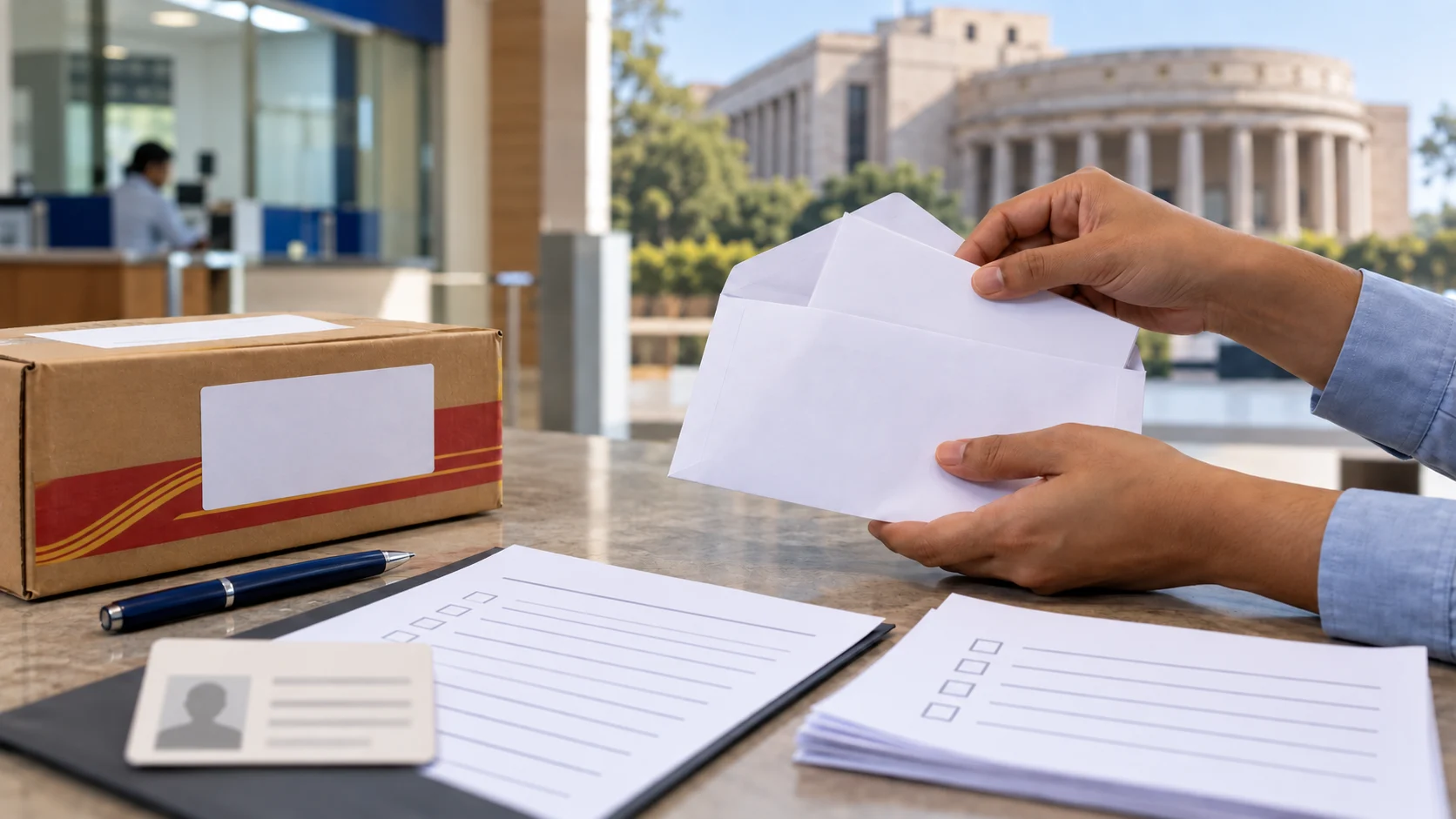
Short answer: A ₹2,000 banknote remains legal tender, but ordinary bank branches no longer provide the special deposit or exchange facility that ended on 7 October 2023. People who still hold these notes can use designated Reserve Bank of India Issue Offices. RBI’s current FAQ says notes may be exchanged there up to ₹20,000 at a time, or submitted for credit to an Indian bank account. People who cannot visit an Issue Office can send the notes through India Post for account credit, subject to RBI’s procedure and verification.
This guide explains the official options, the difference between exchange and account credit, the documents to prepare, the postal route, safety precautions, and what the legal-tender status does—and does not—mean.
What changed for ₹2,000 note exchange?
RBI announced the withdrawal of ₹2,000 denomination banknotes from circulation on 19 May 2023. “Withdrawal from circulation” is not the same thing as immediate demonetisation. RBI asked the public to deposit the notes into bank accounts or exchange them during the initial facility period. The special facility at ordinary bank branches was later discontinued after 7 October 2023.
That change created a practical distinction that still matters. A customer should not assume that a nearby commercial bank branch is required to exchange a ₹2,000 note under the old withdrawal arrangement. The continuing official facility is handled through RBI’s designated Issue Offices. RBI also describes a postal option for people within India who want the value credited to a bank account.
The affected group is anyone who discovers one or more genuine ₹2,000 notes in cash savings, an old envelope, a locker, inherited belongings, or business records. The action to take depends on whether the holder wants cash in exchange or credit to a bank account, how many notes are involved, and whether visiting an RBI Issue Office is practical.
Are ₹2,000 notes still legal tender?
Yes. RBI’s official FAQ says ₹2,000 banknotes continue to be legal tender. This means the notes have not been declared invalid merely because they were withdrawn from circulation.
Legal tender status, however, should not be misunderstood as a promise that every shop, bank counter, or service provider will readily accept the denomination in an ordinary transaction. Businesses may have operational concerns about verification, change, or internal cash policies. The safest official route is therefore not to rely on spending the note. Use an RBI facility and keep an acknowledgement or postal record.
It also does not mean that the original bank-branch exchange window is still open. The legal character of the note and the place where the withdrawal facility is available are separate questions. RBI can maintain legal-tender status while directing the public to specified Issue Offices.
Current official options for ₹2,000 notes
| Option | Where | Main limit or condition | Result |
|---|---|---|---|
| Exchange | Designated RBI Issue Office | Up to ₹20,000 at a time under the FAQ | Value returned in other denomination notes, subject to the office procedure |
| Credit to bank account | Designated RBI Issue Office | Bank and identity details must be verified; conditions may apply | Value credited to an eligible Indian bank account |
| India Post submission | Send to an RBI Issue Office from within India | Use RBI’s prescribed process and include required documents | Value credited to the specified bank account after receipt and verification |
RBI lists 19 Issue Offices for this facility. Before travelling, check the official RBI FAQ and the selected office’s current working hours. A holiday, local security arrangement, queue-management rule, or document requirement can affect a visit even when the national facility remains available.
How to exchange ₹2,000 notes at an RBI Issue Office
- Confirm the office: Use RBI’s official list of Issue Offices, not a map listing or social-media post. Confirm that the office handles the ₹2,000 withdrawal facility.
- Choose exchange or account credit: Exchange is subject to the stated ₹20,000-at-a-time limit. For a larger value, or when cash is not needed, account credit may be more suitable.
- Prepare identification and bank details: Carry original identification and copies if the office instructions request them. For account credit, prepare the account number, IFSC, account-holder name and supporting proof.
- Complete the prescribed form: Write clearly and make sure the bank account belongs to the intended beneficiary. Do not sign a blank form.
- Count the notes and check the acknowledgement: Record the number of notes and total value before handing them over. Keep the stamped receipt or acknowledgement.
- Monitor the result: If account credit is chosen, watch the bank account and preserve the acknowledgement until the credit is received and reconciled.
Example: A person finds six ₹2,000 notes, worth ₹12,000. The amount is below the ₹20,000 exchange ceiling stated in the FAQ, so the person may request exchange at a designated RBI Issue Office, subject to the office’s verification and process. If the person instead wants a traceable non-cash result, account credit can be requested with the required bank details.
For a person holding twelve notes worth ₹24,000, the exchange-at-one-time limit becomes relevant. The holder should not split or structure a transaction merely to avoid legitimate checks. Asking the Issue Office about bank-account credit is the clearer route.
How to send ₹2,000 notes through India Post
RBI’s FAQ provides a route for people within India to send ₹2,000 notes through India Post to an RBI Issue Office for credit to a bank account. This is useful for someone who lives far from an Issue Office, has mobility constraints, or wants to avoid carrying high-value cash on a long journey.
- Open RBI’s official FAQ and download or follow the current postal submission instructions.
- Select the appropriate RBI Issue Office and verify its complete postal address from RBI.
- Prepare the prescribed application or credit form with the account-holder name, account number, bank name, branch and IFSC.
- Attach the identity and bank-account evidence specified by RBI. Do not include unnecessary original documents unless the official instruction explicitly asks for them.
- Count the notes, write down their total value and retain a private record of the denominations and submission date.
- Use the India Post service specified or accepted by RBI, obtain a tracking receipt, and package the contents securely without advertising that the envelope contains currency.
- Track delivery, then monitor the bank account. Keep the postal receipt, tracking result, copies of the form and RBI correspondence until credit is complete.
The postal method is for account credit, not for receiving replacement cash by return mail. It also carries transit and documentation risk. A missing signature, inconsistent account name, incorrect IFSC, incomplete KYC evidence, or weak packaging can delay processing. Check the latest official instructions immediately before dispatch because forms and operational details can change.
Documents and details to prepare
The exact requirement should be taken from the current RBI form and the selected Issue Office. In practical terms, an applicant should be ready with:
- a valid identity document accepted by the process;
- a copy of the bank passbook, statement, or cancelled cheque showing the account holder and account details, when requesting credit;
- the correct account number and IFSC written exactly as held by the bank;
- PAN or other information if required by applicable compliance rules;
- the completed RBI form and any declaration required for the amount or method;
- a safe record of the note count, total value, acknowledgement number, and postal tracking number.
Never share internet-banking passwords, card PINs, UPI PINs, OTPs, or remote-access codes. RBI does not need those credentials to credit a bank account. If anyone asks for them, stop and independently verify the contact through RBI’s official website.
For broader banking safety, see CheckMatter’s guide to reporting an unauthorised bank transaction under RBI rules. You can also review the explainer on how to verify RBI notification claims before trusting a forwarded message.
What does not change
- The ₹2,000 note remains legal tender according to RBI’s FAQ.
- The special withdrawal facility is not the same as the routine cash service at every bank branch.
- The ₹20,000 figure applies to exchange at a time; it should not be confused with a blanket ownership limit.
- Account credit remains subject to successful verification of the notes, applicant information and bank details.
- A genuine RBI process will not require an OTP, UPI PIN, card PIN, or payment to an unofficial agent.
Safety checks and common mistakes
Do not pay a middleman
Claims that an “authorised agent” can unlock a special exchange window for a fee are a warning sign. Use RBI’s published contacts and addresses. Do not hand currency to a courier or individual who is not part of the official postal or RBI process.
Do not rely on an old branch circular
Search results may still show instructions from the 2023 bank-branch window. Check the date and authority. The current question is not whether a branch once accepted the notes, but what RBI says is available now.
Do not confuse damaged-note rules with withdrawal rules
A mutilated, torn, contaminated, or doubtful note may require separate examination under RBI’s note-refund or currency rules. The withdrawal facility does not guarantee automatic value for every damaged or counterfeit note.
Check account-credit details twice
A single wrong digit can cause rejection or delay. Match the beneficiary name, account number and IFSC against a current bank document. If the account is dormant, frozen, closed or subject to restrictions, resolve that first.
Keep evidence until closure
Photographing or photocopying currency can be legally and operationally sensitive, so do not create reproductions that could be misused. A written count, form copy, official acknowledgement and postal receipt are usually the useful records. Store them securely.
If the bank account itself is a concern, CheckMatter’s DICGC deposit-insurance guide explains a different issue: protection for eligible bank deposits. It does not determine whether RBI will accept a ₹2,000 note, but it can help readers understand where credited funds sit.
Is there a deadline?
RBI’s FAQ describes the facility at its 19 Issue Offices as available until further advice. That is not a promise that the arrangement can never change. No new deadline should be inferred from social posts or old news reports. Check RBI immediately before acting, especially before a postal dispatch or long journey.
Because the facility is ongoing rather than tied here to a verified closing date, this article does not create a CheckMatter deadline-tracker entry. If RBI announces a formal end date or changes the process, the article and tracker should be updated from the official release.
Frequently asked questions
Can I exchange a ₹2,000 note at my normal bank branch?
The special bank-branch deposit and exchange facility ended after 7 October 2023. Use the current RBI Issue Office process unless RBI announces another arrangement.
What is the exchange limit?
RBI’s FAQ states that ₹2,000 notes can be exchanged at an RBI Issue Office up to ₹20,000 at a time. Account-credit procedures are distinct and may involve additional verification.
Can I send the notes by post?
Yes. RBI describes an India Post route for people within India to send notes to an RBI Issue Office for credit to a bank account. Follow the latest RBI form, address and documentation requirements.
Will RBI send cash back by post?
The postal facility is described for credit to a bank account. Do not expect replacement currency to be returned in the mail.
Do I need an Aadhaar number?
Use only the identity and KYC documents listed in the current RBI process. Do not assume that a forwarded checklist is authoritative, and never disclose an OTP or biometric credential.
What if the note is damaged?
Damaged or mutilated notes may be assessed under separate RBI rules. Contact the Issue Office through official details before travelling or posting unusual notes.
Does legal tender mean every merchant must accept the note?
Legal-tender status does not guarantee smooth acceptance in every retail transaction. The official RBI route is clearer and provides a record.
Action checklist
- Verify the current facility on RBI’s website.
- Choose exchange or bank-account credit.
- Confirm the correct RBI Issue Office and working hours.
- Prepare identity and bank evidence required by the current form.
- For postal credit, use India Post and retain tracking.
- Never share an OTP, UPI PIN, card PIN or banking password.
- Keep the acknowledgement until cash exchange or account credit is complete.
Conclusion
For a ₹2,000 note exchange today, start with RBI—not an ordinary bank branch, agent, or viral message. The note remains legal tender, but the dedicated route is through designated RBI Issue Offices. Exchange is available up to ₹20,000 at a time under the official FAQ, while account credit and the India Post route offer alternatives for larger holdings or people who cannot visit easily. Verify the latest procedure immediately before travel or dispatch and keep a complete paper trail.
Official sources: RBI FAQ on withdrawal of ₹2,000 denomination banknotes; RBI currency press release.
Author: CheckMatter Editorial Desk
Publication date: Proposed 6 October 2026
Updated date: 2 October 2026
Last verified: 2 October 2026
Correction history: No corrections; initial draft.
Editorial note: Recommended canonical URL: https://checkmatter.in/2000-note-exchange-rbi-office-india-post/. Recommended schema: Article with FAQPage markup only for FAQs visibly present on the page.
Disclaimer: This is general public-information guidance, not legal, tax, or financial advice. Operational requirements can change. Confirm the latest instructions directly with RBI and your bank before acting.
Leave a Reply