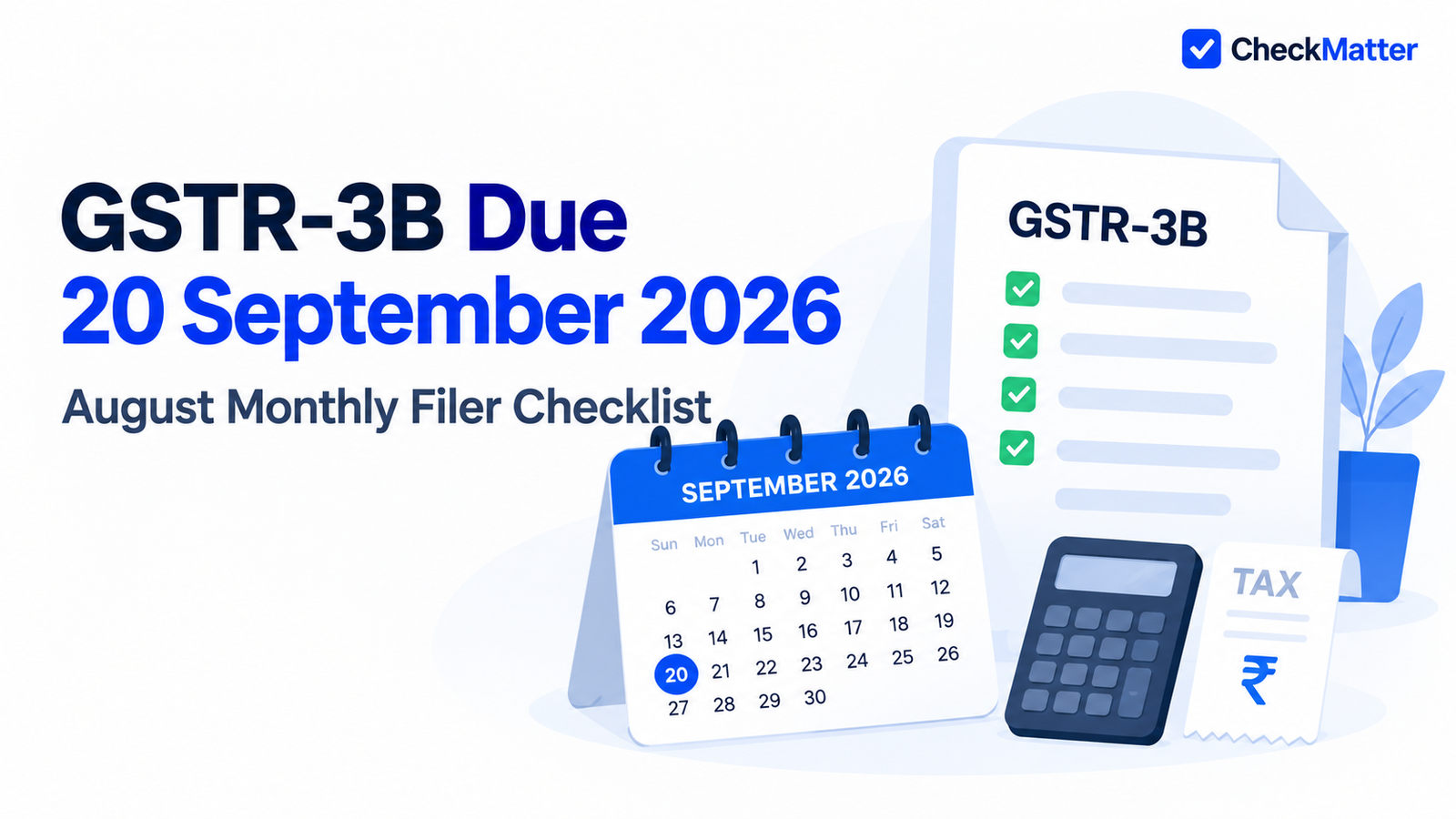
Quick answer: Taxpayers who file Form GSTR-3B monthly are ordinarily due to file the return for August 2026 by 20 September 2026. Quarterly filers under the QRMP scheme generally follow different state-group deadlines after the quarter, so they should not use the monthly date automatically. Before filing, reconcile outward supplies, eligible input tax credit, reverse-charge liability, electronic ledgers and tax payment.
Verified from: Goods and Services Tax Network guidance and official GST materials checked 15 September 2026. Any extension must come from an official notification or portal advisory.
GSTR-3B is a summary return used to declare GST liabilities, eligible input tax credit and tax payment. The form may contain system-generated figures, but the registered person remains responsible for the return. Auto-population is an assistance feature, not a guarantee that every invoice, credit note, amendment or reverse-charge item is correct.
What is the GSTR-3B due date for August 2026?
For a registered person filing GSTR-3B monthly, the ordinary due date is the 20th day of the month following the tax period. For the August 2026 return, that date is 20 September 2026. CheckMatter’s verified deadline entry records the date and official source.
Do not treat this article as proof that no extension exists. GST deadlines can be changed for specified taxpayers, regions or periods through official notifications. Check the GST portal, CBIC notifications and your return dashboard before acting.
Are you a monthly filer or a QRMP filer?
The first check is filing frequency. A monthly filer submits GSTR-3B for August by the monthly due date. A taxpayer under the Quarterly Return Monthly Payment scheme files the quarterly GSTR-3B after the quarter and generally pays tax for the first two months using the prescribed challan process.
GSTN’s QRMP advisory describes different quarterly GSTR-3B deadlines—ordinarily the 22nd or 24th of the month after the quarter depending on the state or union territory of the principal place of business. Those are not the deadline for a normal monthly August return.
Verify the filing frequency shown on the GST portal. Do not rely on last year’s practice if an option was changed, turnover conditions changed or a registration was newly obtained.
Who should prepare the return?
The registered person is legally responsible, even where an accountant, GST practitioner or software provider prepares the data. A sound process separates preparation, review and filing authority. The reviewer should see the reconciliation and exceptions, not merely the final tax figure.
Small businesses should avoid handing unrestricted portal, bank or OTP access to an unknown consultant. Use authorised users and retain control over the filing confirmation and payment.
Reconciliation before filing GSTR-3B
1. Outward supplies
Compare the sales register with invoices, debit notes, credit notes and amendments for August. Classify taxable, exempt, nil-rated, zero-rated and non-GST supplies correctly. Check place of supply and tax type so that IGST is not incorrectly treated as CGST and SGST, or vice versa.
2. GSTR-1 or invoice data
Reconcile the outward-liability summary with GSTR-1 information. Timing differences or later amendments should be documented. A mismatch can affect recipients and may require correction through the permitted process.
3. Input tax credit
Review purchase records against the system-generated statement and apply eligibility restrictions under the current law. Do not claim credit merely because an invoice appears in accounting software. Confirm supplier details, receipt of goods or services, tax invoice requirements, business use and any blocked-credit rule.
4. Reverse charge
Identify supplies on which the recipient must pay tax under reverse charge. The liability and related credit, where eligible, follow separate conditions and should not be netted casually against normal purchases.
5. Prior-period corrections
List errors discovered from earlier returns and determine whether, where and when the current GST framework permits correction. GSTR-3B is not freely revisable after filing, so a planned adjustment should have a documented basis.
6. Electronic ledgers
Check the electronic liability register, credit ledger and cash ledger. Understand which liability can be discharged with eligible credit and which requires cash. A cash balance alone does not file the return.
A five-record control table
| Record | Key question |
|---|---|
| Sales register | Are August outward supplies complete and correctly classified? |
| GSTR-1 data | Does reported invoice information support the liability? |
| Purchase register | Are invoices genuine, received and business-related? |
| GSTR-2B or applicable statement | Which credits are reflected and which need review? |
| Electronic ledgers | Is enough eligible credit and cash available to discharge liability? |
Example: why auto-populated figures still need review
Assume a business’s accounting system shows ₹6 lakh of taxable outward supplies for August. One credit note of ₹20,000 was issued but not included in the prepared summary. The purchase register shows input tax credit of ₹70,000, while the relevant system statement supports only ₹58,000 and ₹4,000 relates to a blocked category.
The filer should not accept a single auto-populated number. It should determine the correct outward liability, handle the credit note through the proper reporting route, claim only eligible credit and document the remaining mismatch for follow-up. The example is illustrative; the correct tax depends on rate, place of supply and current law.
How to file the August 2026 GSTR-3B
- Sign in at the official GST portal.
- Open the Returns Dashboard and select the correct financial year and August 2026 tax period.
- Confirm that the displayed filing frequency is monthly.
- Open Form GSTR-3B and review system-generated details.
- Enter or confirm outward supplies, reverse-charge liability and other required tables.
- Review eligible and ineligible input tax credit using the current legal rules.
- Preview the draft return and compare it with the approved reconciliation.
- Use the payment or offset-liability workflow and add cash through an authorised challan where needed.
- File using the permitted electronic verification method.
- Save the filed return, acknowledgement or ARN, challan and ledger evidence.
Do not stop after creating a challan or adding money to the cash ledger. Filing is complete only when the return shows a successful filed status and the acknowledgement is available.
Payment planning
Start before the final hours of 20 September. Bank cut-offs, failed payments, portal load or a wrong challan can delay completion. Estimate cash needs after reviewing eligible credit, create the challan through the official portal and verify that the deposit appears in the electronic cash ledger.
Never transfer GST money to a personal account supplied over chat. The official portal-generated payment route and authorised banking options should control the transaction.
What happens if GSTR-3B is filed late?
Delayed filing can attract late fee and interest under the applicable GST provisions. Interest may apply to delayed tax payment, while late fee relates to delayed return filing. Rates, caps and relief can vary by period and official notification, so use current portal calculations and legal guidance.
Late filing can also block the filing sequence for later periods and disrupt compliance records. Where a return is overdue, calculate the liability, file promptly and document any system issue. Do not assume that a nil return can be ignored; a registered person with a filing obligation may need to submit it even when there is no business activity.
Common GSTR-3B mistakes
- Using 20 September even though the registration follows QRMP.
- Choosing the wrong tax period or GSTIN.
- Copying GSTR-1 totals without checking later notes and amendments.
- Claiming all purchase-register tax as input credit.
- Ignoring reverse-charge supplies.
- Using the wrong tax head when offsetting liability.
- Leaving money in the cash ledger without filing the return.
- Assuming a portal message or unofficial screenshot extends the due date.
- Failing to retain the ARN and final filed copy.
What does not change
Filing GSTR-3B does not replace invoice-level reporting, proper books, e-invoice obligations, e-way bill compliance or annual reconciliation where applicable. It also does not correct an earlier filed return automatically. Each obligation follows its own rules and dates.
The article’s date applies to the August 2026 monthly return. It should not be reused for another tax period without checking the official calendar.
Portal or bank failure: what to record
- GSTIN, tax period and action attempted
- time-stamped error message or portal reference
- challan identification details without exposing credentials
- bank debit reference and status
- official grievance or helpdesk ticket
- subsequent ledger and filing-status checks
Preserving evidence does not itself remove interest or late fee. It supports accurate follow-up and any representation available under current rules.
Official sources
- GSTN user guide for Form GSTR-3B
- GSTN advisory on the QRMP scheme
- Official GST portal
- CBIC Central Tax notifications
Frequently asked questions
Is the August 2026 GSTR-3B deadline 20 September?
Yes for ordinary monthly filers, unless a valid official notification changes it for the relevant class or area.
Do QRMP taxpayers file August GSTR-3B by 20 September?
Generally no. QRMP taxpayers follow the quarterly-return structure and monthly-payment process. Verify the portal-selected frequency.
Can GSTR-3B be revised after filing?
It is not freely revisable like an ordinary draft. Errors must be handled through the correction mechanism permitted by current GST law.
Is GSTR-2B the only check needed for input tax credit?
No. It is an important statement, but eligibility also depends on invoice, receipt, business use, supplier and blocked-credit conditions.
Does creating a challan count as filing?
No. Complete payment or offset and file the return successfully. Retain the ARN and filed copy.
Action checklist before 20 September
- Confirm monthly filing frequency.
- Reconcile sales, GSTR-1 and credit notes.
- Reconcile purchases and eligible input tax credit.
- Check reverse charge and previous-period corrections.
- Review electronic ledgers and cash requirement.
- Preview and approve the return.
- Pay or offset liability and file.
- Save the ARN, filed return and challan records.
For more practical tax coverage, read the September advance-tax guide and browse Tax & GST.
Effective date: Ordinary monthly-filer deadline 20 September 2026 for August 2026. Last verified: 15 September 2026.
Correction history: First draft; no corrections recorded.
Tax disclaimer: This guide is general information, not personalised tax or legal advice. GST treatment depends on registration, filing frequency, transactions and current notifications.
Leave a Reply