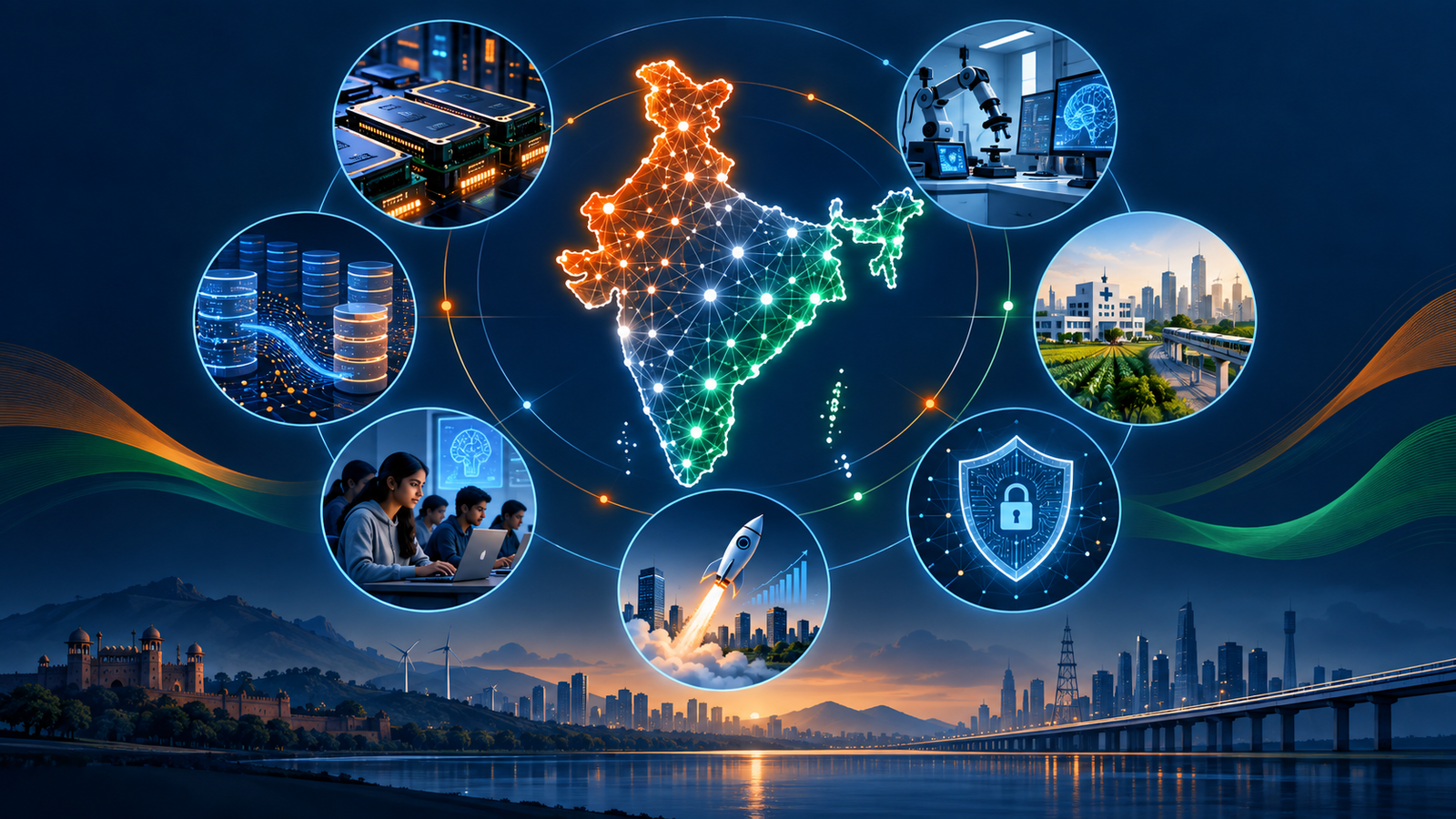
Quick answer: The IndiaAI Mission is the Government of India’s national programme for strengthening the country’s artificial-intelligence ecosystem. Approved by the Union Cabinet on 7 March 2024 with an outlay of ₹10,371.92 crore, it is organised around seven components: compute capacity, an innovation centre and indigenous models, a datasets platform, application development, future skills, startup financing, and safe and trusted AI. It is infrastructure and ecosystem policy—not a universal cash-benefit scheme. Access to a particular programme depends on that programme’s eligibility rules and active application window.
Verified from: Press Information Bureau, IndiaAI and Ministry of Electronics and Information Technology official sources, checked 13 September 2026.
“IndiaAI Mission” can sound abstract until the seven pillars are translated into practical questions: Who can rent subsidised computing resources? Where can a researcher find useful datasets? How can a student enter an AI course or fellowship? Which startups may receive support? What safeguards are being built for responsible deployment? This guide explains the policy architecture and shows how to check real opportunities without confusing a mission announcement with an open application.
What the IndiaAI Mission is
The Cabinet approval describes a comprehensive national mission intended to catalyse AI innovation through public- and private-sector partnerships. The programme is implemented by the IndiaAI Independent Business Division under Digital India Corporation, within the Ministry of Electronics and Information Technology.
The original approval combined several bottlenecks into one mission. Advanced AI work needs costly computing, high-quality datasets, technical talent, research and model development, demand from real sectors, patient startup capital and credible safety mechanisms. The seven pillars address those constraints as connected parts of an ecosystem.
| Mission fact | Official position |
|---|---|
| Cabinet approval | 7 March 2024 |
| Approved outlay | ₹10,371.92 crore |
| Implementation body | IndiaAI Independent Business Division under Digital India Corporation |
| Number of pillars | Seven |
| Main approach | Shared infrastructure, innovation, skills, applications, financing and responsible AI |
The seven pillars of the IndiaAI Mission
1. IndiaAI Compute Capacity
Training and running modern AI systems requires graphics processing units, storage, networking and specialised cloud software. The Cabinet approval proposed a high-end, scalable computing ecosystem of 10,000 or more GPUs through a public-private partnership, together with a marketplace for AI services and pre-trained models.
The official IndiaAI Compute Portal now describes cloud compute, network, storage and platform services for eligible users including researchers, academic faculty, students, startups, MSMEs, government organisations and other approved entities. Eligibility is not identical for every category. Applicants should read the current portal policy, required documents, subsidy or pricing terms, project review and acceptable-use conditions before planning workloads.
Practical meaning: a qualifying team may be able to access infrastructure without purchasing its own GPU cluster. That can lower entry barriers, but it does not eliminate engineering costs, data responsibilities or the need to control cloud consumption.
2. IndiaAI Innovation Centre
The original mission design assigned the IndiaAI Innovation Centre responsibility for developing and deploying indigenous large multimodal models and domain-specific foundation models for critical sectors. Later public communications may use terms such as foundation models when describing this work.
Practical meaning: the pillar aims to build models suited to Indian languages, data and use cases rather than relying entirely on external general-purpose systems. Researchers, startups and consortia should watch official calls for proposals. A mission-level objective is not, by itself, an invitation to submit; eligibility, intellectual-property terms, milestones and deadlines come from each notice.
3. IndiaAI Datasets Platform
AI systems depend on data that is discoverable, documented and usable under clear conditions. The Cabinet announcement called for a unified platform to improve access to quality non-personal datasets for Indian startups and researchers. The operational platform is commonly presented as AIKosh or AIKosha in current government communications.
Practical meaning: developers can search for datasets, models, toolkits or related resources instead of building every input from the beginning. Availability on a platform does not mean unrestricted use. Review the licence, permitted purpose, attribution requirements, privacy safeguards and quality notes for each resource.
4. IndiaAI Application Development Initiative
This pillar focuses on practical AI solutions for problem statements sourced from central ministries, state departments and other institutions. The stated aim is to develop, scale and promote applications capable of significant socioeconomic impact.
Practical meaning: innovators may see challenges, calls, hackathons or procurement-linked opportunities in sectors such as healthcare, agriculture, education, governance and climate. A good proposal needs more than an impressive model: it should define the user, data availability, deployment environment, measurable outcome, safety risks and path from pilot to scale.
5. IndiaAI FutureSkills
The mission’s skills pillar was designed to reduce barriers to entry into AI programmes, increase AI courses at undergraduate, postgraduate and doctoral levels, and support Data and AI Labs in Tier 2 and Tier 3 cities. Official programmes can include courses, labs and research fellowships, each with separate requirements.
Practical meaning for students: look for a specific course, institution, fellowship notice or lab rather than searching only for “IndiaAI registration.” Verify academic level, full-time status, institution participation, selection method, stipend conditions and closing date directly in the current notice.
6. IndiaAI Startup Financing
This component is intended to support and accelerate deep-tech AI startups and improve access to funding for ambitious projects. Startup support can take different operational forms and may be delivered through selected mechanisms or partners.
Practical meaning for founders: do not treat the approved mission outlay as money available through a general online claim. Watch for official expressions of interest, fund or accelerator announcements, selection criteria and due-diligence terms. Prepare evidence of technical differentiation, India-relevant impact, data rights, responsible-AI controls and a credible deployment plan.
7. Safe & Trusted AI
The Cabinet approval recognised the need for guardrails and described responsible-AI projects, indigenous tools and frameworks, self-assessment checklists, guidelines and governance frameworks. Subsequent official calls have covered areas such as risk assessment, bias mitigation, privacy, explainability and detection of manipulated content.
Practical meaning: safety is a technical and operational requirement, not just a policy appendix. Teams seeking mission-linked opportunities should document testing, human oversight, security, privacy, grievance handling and limitations. Organisations adopting AI should maintain their own governance even when a model or resource comes from an official ecosystem.
What the mission means for different groups
| Group | Most relevant pillars | Useful next step |
|---|---|---|
| Students | FutureSkills, datasets, compute | Check active courses, labs, fellowships and eligibility notices |
| Researchers | Compute, datasets, innovation centre, safe AI | Define a project, institution support, resource need and data plan |
| Startups | Compute, financing, applications, foundation models | Track official calls and prepare technical, financial and governance documents |
| MSMEs | Compute and application adoption | Start with a measurable business problem and total cost assessment |
| Government bodies | Applications, datasets, safe AI | Frame problem statements, procurement outcomes and safeguards |
| AI professionals | FutureSkills, safe AI, applications | Build deployable skills and follow public challenges or evaluation projects |
How to find a genuine IndiaAI opportunity
- Start at an official domain. Use IndiaAI, its programme portals, MeitY or PIB. Be cautious with copied notices on social media.
- Identify the exact programme. “IndiaAI Mission” is the umbrella; compute access, fellowships and calls for proposals are separate opportunities.
- Check whether applications are open. An old announcement may remain online after its deadline.
- Read the complete guidelines. Confirm applicant type, geography, institution status, documents, evaluation, costs and deliverables.
- Verify the submission route. Apply only through the portal or address named in the official notice.
- Record the deadline and timezone. Do not infer a closing time when only a date is shown; seek clarification from the listed contact.
- Keep the acknowledgement. Save application number, submitted files and official correspondence.
Common misunderstandings
“Every student can get free GPUs”
The mission seeks to democratise access, and the compute portal lists students among eligible user groups, but access is governed by current eligibility, approval, documentation, allocation and pricing or subsidy rules. It is not an unlimited personal entitlement.
“₹10,371.92 crore is a startup grant pool”
The approved outlay supports the whole seven-pillar mission. Startup financing is one component. A founder must use the application channel and terms of an actual financing programme.
“Government datasets are automatically open for any purpose”
Each dataset can carry conditions, quality limits and privacy or security restrictions. Check the licence and documentation. Responsible use remains the user’s duty.
“Safe and Trusted AI means every listed tool is risk-free”
No AI system is made risk-free by association with a mission. Deployers must evaluate accuracy, bias, privacy, security, human oversight and sector-specific legal duties in their own context.
A practical preparation checklist for applicants
Whether applying for compute, research support or a challenge, prepare a concise project note containing:
- the problem and intended users;
- why AI is necessary rather than merely fashionable;
- the dataset source, licence, quality and privacy basis;
- model and compute requirements with cost estimates;
- evaluation metrics and a baseline;
- security, safety, bias and misuse controls;
- team capability and institutional support;
- deployment plan, milestones and expected public or economic value; and
- how results will be sustained after the programme period.
For tool selection in day-to-day work, read our ChatGPT vs Gemini vs Copilot practical choice guide. The commercial assistant you use today and the public AI infrastructure India is building are related parts of the digital economy, but they are not interchangeable.
What changed, what did not, and what to do
What changed: the 2024 Cabinet decision created a funded national framework bringing compute, models, datasets, applications, skills, financing and governance into one mission. Operational portals and individual programmes have developed under that framework.
What did not change: approval of the mission does not automatically approve an individual applicant, waive data obligations or guarantee funding. Existing education, company, procurement, intellectual-property and sector rules still matter.
What to do now: choose the pillar that matches your need, locate the current official programme page, confirm its status and eligibility, and prepare evidence for that specific application. If no suitable window is open, monitor IndiaAI and MeitY announcements rather than paying an intermediary promising guaranteed selection.
Official sources
- PIB: Cabinet approves the IndiaAI Mission
- IndiaAI official portal
- IndiaAI Compute Portal
- AIKosh datasets and innovation platform
- Ministry of Electronics and Information Technology
Frequently asked questions
When was the IndiaAI Mission approved?
The Union Cabinet approved it on 7 March 2024.
What is the IndiaAI Mission budget?
The Cabinet announcement gives an approved outlay of ₹10,371.92 crore for the national mission.
How many pillars does the mission have?
Seven: compute capacity, innovation centre/foundation models, datasets, application development, future skills, startup financing, and safe and trusted AI.
Can students apply?
Students are relevant to programmes such as FutureSkills and may be eligible for specified compute or fellowship opportunities. They must follow the rules of the exact programme and active notice.
Can a small business use IndiaAI Compute?
The official compute portal includes MSMEs among eligible categories, subject to the portal’s current criteria, supporting documents, approval and service terms.
Is IndiaAI a replacement for ChatGPT or other AI assistants?
No. IndiaAI is a national ecosystem mission. It can support infrastructure, models, datasets, applications and skills; it is not a single consumer chatbot.
Final action list
- Select the pillar connected to your real need.
- Visit the official IndiaAI or programme portal.
- Confirm the notice is current and applications are open.
- Read eligibility, cost, deliverables and deadline details.
- Prepare a measurable project and responsible-AI plan.
- Apply only through the official route and keep acknowledgement.
- Re-check official updates before spending money or sharing sensitive documents.
Effective date: Cabinet approval on 7 March 2024. Last verified: 13 September 2026.
Technology-policy disclaimer: Programme names, portals, eligibility, pricing, subsidies and deadlines can change. This explainer is not a promise of admission, funding or resource allocation; the current official notice controls.
Independent professionals exploring practical AI adoption may also find our ChatGPT in 2026 guide for Indian freelancers useful.